
What Happens When Differential Pressure Rises in a High Flow Filter?
Differential pressure is one of the most useful operating indicators in a high flow filtration system.
As a filter cartridge captures suspended solids and other contaminants, resistance to flow gradually increases. This causes the pressure difference between the upstream and downstream sides of the filter to rise.
A rising differential pressure does not automatically mean the filter is defective. In many cases, it simply shows that the filter is doing its job and becoming progressively loaded.
However, when differential pressure rises too quickly, it can indicate problems with filter selection, flow rate, feed-water quality or upstream pretreatment.
Understanding what happens inside the filter can help operators make better decisions about filter change-out timing, system troubleshooting and replacement selection.
What Is Differential Pressure in a High Flow Filter?
Differential pressure, often written as ΔP, is the difference between the pressure measured before and after the filter cartridge.
In simple terms:
Differential Pressure = Upstream Pressure − Downstream Pressure
When a filter is clean, water can pass through the filter media with relatively low resistance.
As contaminants accumulate in the media, the available flow paths become more restricted. The system must then overcome greater resistance to maintain the same flow.
As a result, differential pressure gradually increases.
This is why ΔP is commonly used as an indicator of filter loading.
What Happens Inside the Filter as Contaminants Accumulate?
A high flow filter does not normally move from “clean” to “blocked” immediately.
The process happens gradually.
Stage 1: Clean Filter
When the cartridge is newly installed, most of the available filtration area is open.
At this stage:
- flow resistance is relatively low
- differential pressure is low
- the media has maximum available dirt-holding capacity
Stage 2: Filter Loading Begins
As particles are captured, some of the pores and flow paths in the media become occupied.
At this stage:
- resistance begins to increase
- differential pressure starts to rise
- contaminants continue to spread through the available filtration area
Stage 3: Higher Filter Loading
As more contaminants accumulate, the remaining open flow paths become more restricted.
At this stage:
- differential pressure increases more noticeably
- available filtration area becomes more limited
- the filter approaches its recommended change-out condition
The exact rate of pressure increase depends on many factors, including contaminant loading, flow rate, filter media and cartridge design.
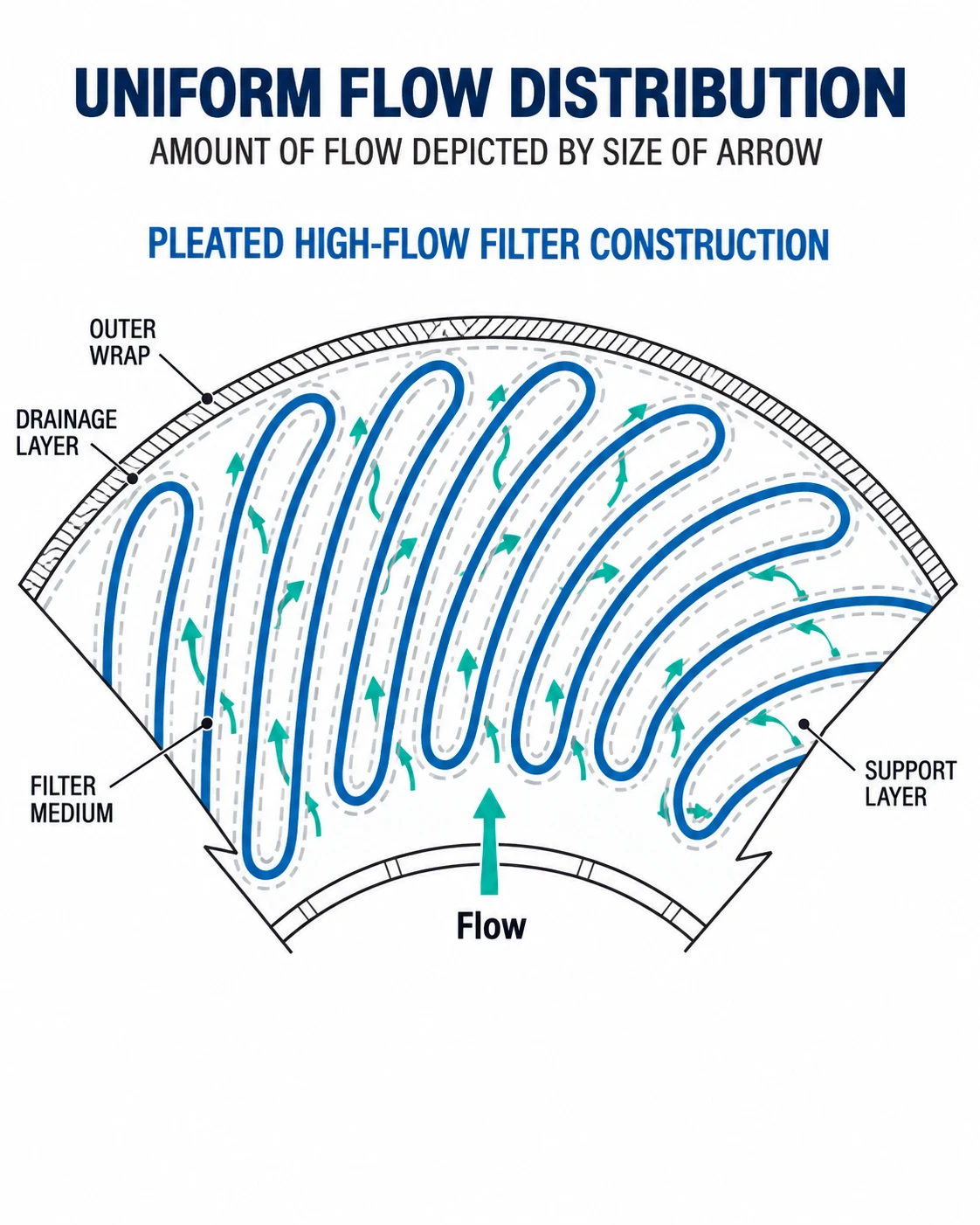
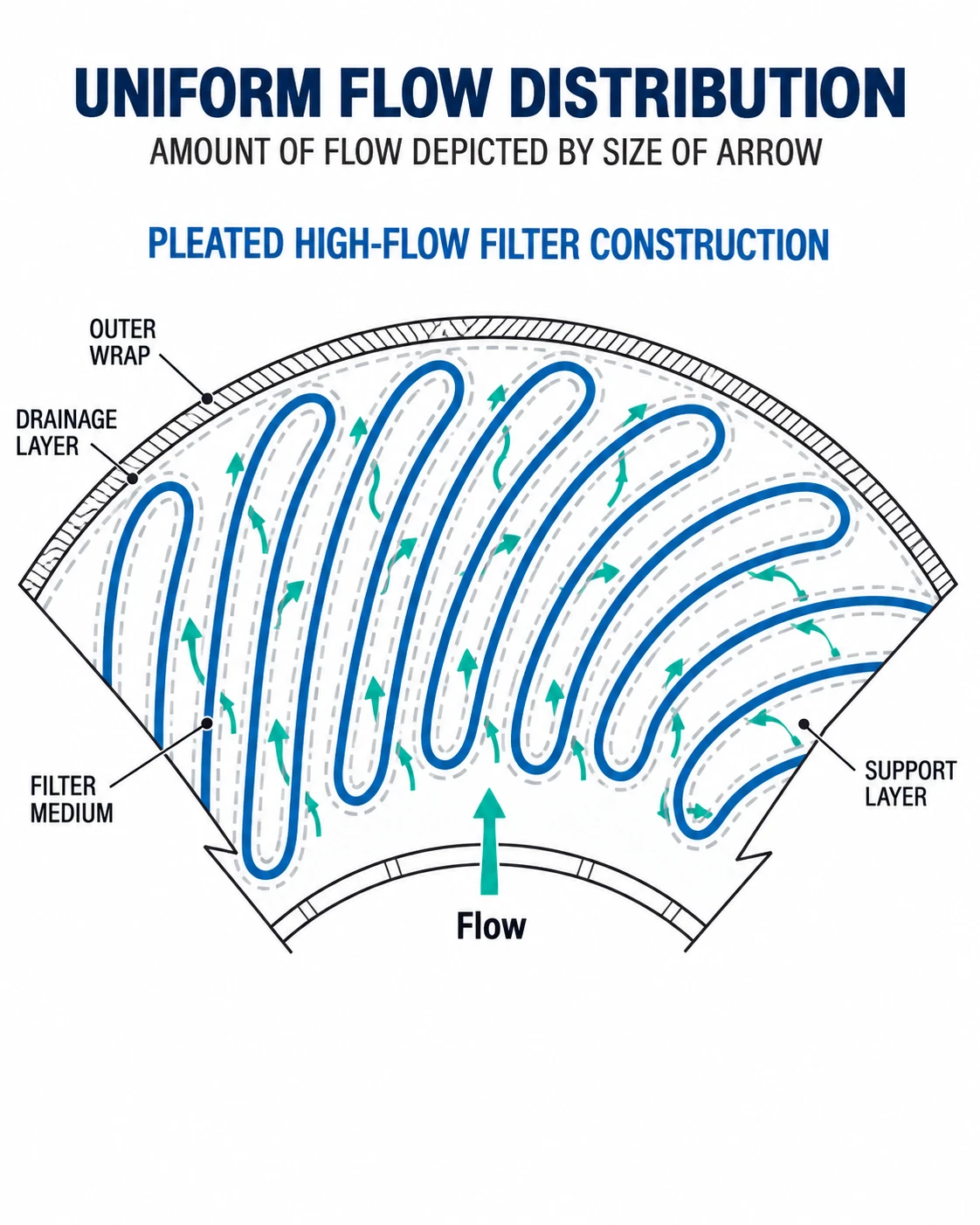
Why Pleat Geometry and Flow Distribution Matter
Two high flow filter cartridges can have similar dimensions and the same micron rating, but still develop differential pressure differently.
One reason is pleat geometry.
Pleat design affects how effectively the filter media is used.
Important factors include:
- pleat depth
- pleat spacing
- pleat count
- media support
- flow path design
If flow is distributed evenly across the media, more of the available filtration area can participate in contaminant capture.
This can help reduce localized loading.
By contrast, if certain areas receive significantly more flow than others, those sections may load faster.
This can lead to:
- uneven contaminant accumulation
- faster local blockage
- more rapid differential pressure increase
- less effective use of the total filter media
Common Reasons Differential Pressure Rises Too Fast
A rapid increase in differential pressure does not always mean the cartridge itself is the root cause.
Several system conditions can accelerate filter loading.
1. Higher Suspended Solids Loading
If the feed water suddenly contains more suspended particles, the filter will capture contaminants faster.
This can shorten the service interval even when the cartridge specification has not changed.
2. Increased Flow Rate
Higher flow can increase hydraulic resistance.
It may also cause contaminants to load the media more quickly.
When comparing differential pressure data, flow rate should always be considered.
3. Micron Rating Is Too Fine
Using a finer filter than the application requires can cause faster loading.
For example, moving from a relatively coarse filter to a much finer cartridge may improve particle removal but also increase pressure drop and shorten service life.
4. Upstream Pretreatment Has Changed
Changes in upstream filtration, clarification or chemical treatment can affect the contaminant load reaching the high flow filter.
A problem upstream may appear as rapid cartridge loading downstream.
5. Feed-Water Quality Has Changed
Seasonal variation, raw-water changes or process fluctuations can all change the amount and type of contaminants entering the system.
This is especially common in RO pretreatment and industrial water treatment applications.
Why Initial Pressure Drop Also Matters
Most operators focus on how fast ΔP rises over time, but the initial clean pressure drop is also important.
A high initial differential pressure may indicate:
- excessive operating flow
- insufficient filtration area
- unsuitable filter media
- restrictive cartridge design
- incorrect installation
- housing-related flow limitations
When comparing two replacement cartridges, both the initial pressure drop and the rate of pressure increase should be considered.
A cartridge with lower initial resistance but poor dirt-holding performance may not necessarily provide longer service life.
Likewise, a cartridge with more filtration area may perform better under loading conditions even if the basic micron rating is the same.
When Should a High Flow Filter Be Replaced?
A filter should not be changed based on appearance alone.
Replacement timing is normally determined by the requirements of the filtration system.
Common indicators include:
- reaching the recommended terminal differential pressure
- unacceptable reduction in system flow
- downstream quality no longer meeting requirements
- process operating limits being reached
- planned maintenance intervals
The correct change-out differential pressure should be based on the filter specification, housing design and system operating conditions.
Operators should avoid using one universal ΔP value for every high flow filter application.
How to Compare Two Replacement Filters Using Differential Pressure Behavior
When comparing an OEM filter with a compatible replacement, micron rating alone is not enough.
It is useful to evaluate:
- clean pressure drop
- flow capacity
- effective filtration area
- filtration efficiency
- media construction
- pleat geometry
- dirt-holding behavior
- differential pressure development
- recommended terminal ΔP
Two filters with the same length and micron rating can still behave differently during actual operation.
This is why a proper replacement should be selected according to the complete operating requirements of the system.
Differential Pressure Should Be Viewed as a Trend
A single ΔP reading provides limited information.
The trend over time is often much more useful.
For example:
Stable gradual increase
may indicate normal filter loading.
Sudden rapid increase
may indicate a change in feed-water quality, flow rate or upstream conditions.
High ΔP immediately after installation
may indicate incorrect selection, installation or excessive flow.
Tracking differential pressure regularly can help operators identify changes before they become larger system problems.
Conclusion
Differential pressure is more than just a number on a pressure gauge.
It provides useful information about how a high flow filter is loading and how the filtration system is operating.
A rising ΔP is normally expected as contaminants accumulate, but the rate of increase can be influenced by:
- filtration area
- pleat geometry
- media structure
- flow distribution
- contaminant loading
- operating flow
- upstream pretreatment
When differential pressure rises faster than expected, the best approach is to evaluate the whole system rather than blaming the cartridge immediately.
Filter performance should be evaluated by how well the cartridge matches the real operating conditions — not just by micron rating or dimensions.
Need Help Cross-Referencing a High Flow Filter?
Send us your OEM part number, micron rating and application conditions. Our team can help verify a suitable compatible high flow filter replacement solution.