
Why Does a High Flow Filter Cartridge Look Dirty but Show Little Increase in Differential Pressure?
A high flow filter cartridge can look heavily contaminated while differential pressure remains surprisingly low. Flow rate, micron rating, pore structure, contaminant type, sealing condition and actual filtration efficiency can all influence how differential pressure develops over time.
Need Help Evaluating Your Filter?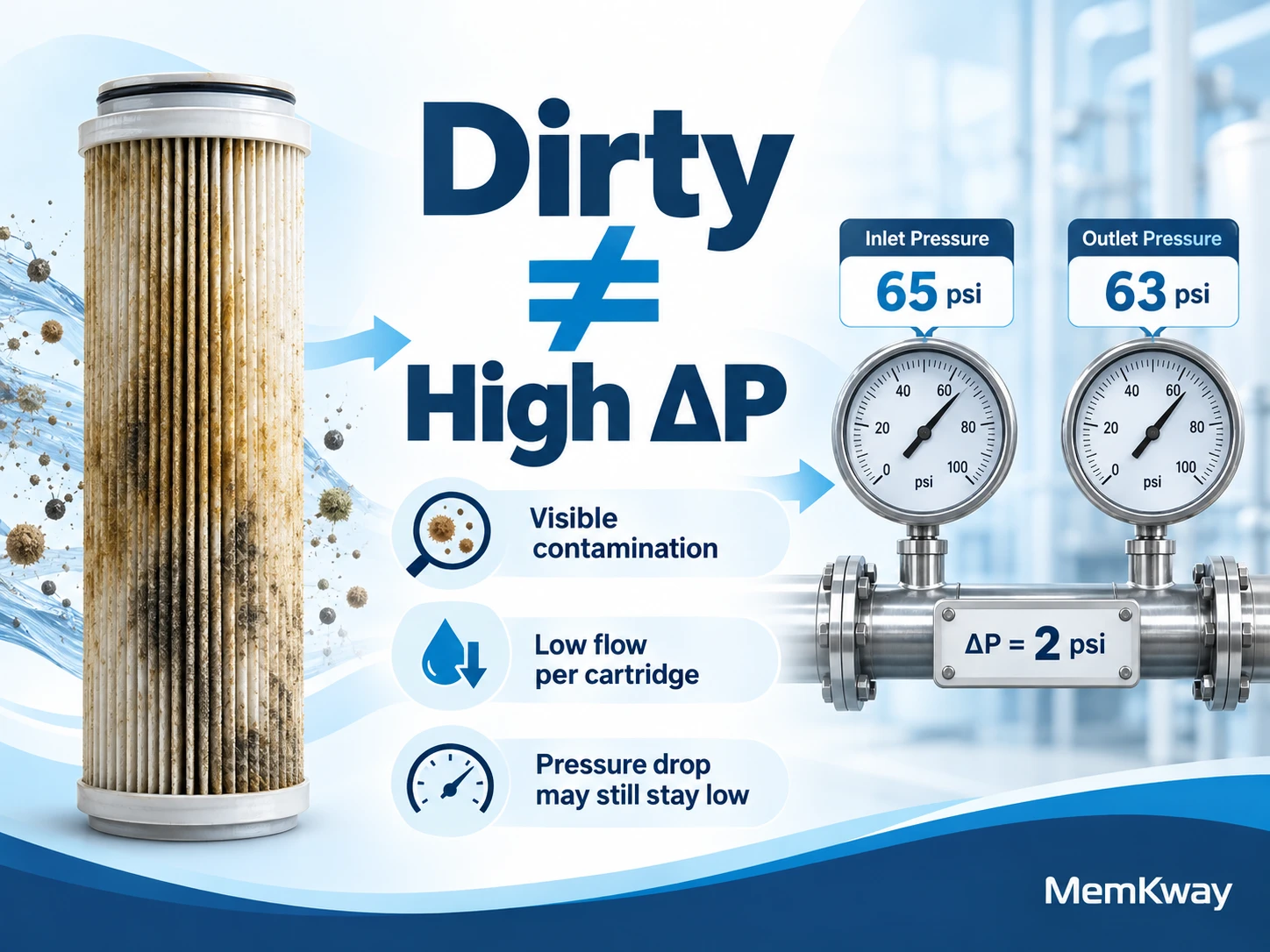
Dirty Cartridge, Low ΔP — Is This Normal?
Consider a filtration system using seven 60-inch high flow cartridges at a total water flow of 73 L/s.
per 60-inch cartridge
Six Main Reasons for This Situation
Low Flow per Cartridge
Lower flow usually means lower initial hydraulic resistance. A considerable amount of contaminant may accumulate before a large increase in ΔP becomes visible.
Nominal 5 μm Does Not Mean Absolute 5 μm
A 5 μm nominal cartridge does not necessarily remove nearly all particles larger than 5 μm.
Actual retention efficiency depends on filter media structure, pore size distribution, fiber density and the manufacturer's definition of “nominal”.
| 5 μm Nominal | 5 μm Absolute |
|---|---|
| Efficiency may vary | Higher defined efficiency |
| Manufacturer-dependent | More clearly defined |
| Some fine particles may pass | Higher retention near rated size |
The Effective Pore Structure May Be More Open
If the actual pore size distribution is more open than expected, larger particles may be retained while a portion of finer particles continues downstream.
The cartridge may therefore look very dirty without the media becoming deeply blocked.
Contaminant Type Matters
Different contaminants affect differential pressure differently.
- Hard solids: sand, rust and scale may create a dense cake layer.
- Soft solids: organic matter and sludge may look dirty but still allow water to pass.
- Fine particles: may penetrate deeper or pass through depending on retention efficiency.
O-Ring Sealing or Cartridge Bypass
If the cartridge is not fully seated or the O-ring does not seal correctly, part of the water may bypass the filter media.
- Damaged O-ring
- Incorrect O-ring size
- Improper cartridge seating
- Dimensional mismatch
- Insufficient compression
Bypass should not be assumed from appearance alone, but it should be ruled out when ΔP remains unusually low for a long period.
Pressure Is Being Checked, but Not Properly Trended
A single pressure reading provides limited information.
Inlet pressure, outlet pressure, flow rate and operating time should be recorded regularly.
What Should You Check First?
Observe the actual ΔP trend over time.
Particle count is preferred; turbidity and SDI can also help.
Lower flow can significantly reduce differential pressure.
Rule out possible bypass around the seal.
How to Verify Whether the Filter Is Actually Removing Fine Particles
Comparing upstream and downstream particle concentration is one of the most direct ways to evaluate actual filter performance.
This is particularly useful when evaluating nominal-rated filter cartridges because it measures actual retention rather than relying only on the stated micron rating.
| Particle Size | Upstream | Downstream | Removal |
|---|---|---|---|
| ≥5 μm | 10,000 | 3,500 | 65% |
| ≥10 μm | 4,000 | 600 | 85% |
| ≥20 μm | 1,000 | 50 | 95% |
Why This Matters in RO Pretreatment
Low differential pressure does not automatically prove good filtration performance. Fine particles passing downstream may still affect the RO system.
How to Compare Two High Flow Filter Cartridges Fairly
The cartridges should be tested under equivalent conditions whenever possible.
Keep These Conditions the Same
Compare These Results
Evaluate Filter Performance with Data, Not Appearance Alone
A high flow filter cartridge can look heavily contaminated while the differential pressure remains relatively low.
This may be related to flow rate, nominal micron rating, pore structure, contaminant characteristics, sealing condition or insufficient monitoring.
Not Sure Whether Your Current High Flow Cartridge Is Performing as Expected?
Send us your current cartridge model, micron rating, flow rate and operating conditions. MemKway can help review your application and recommend a suitable replacement or comparison test.
Compatible High Flow Replacements